
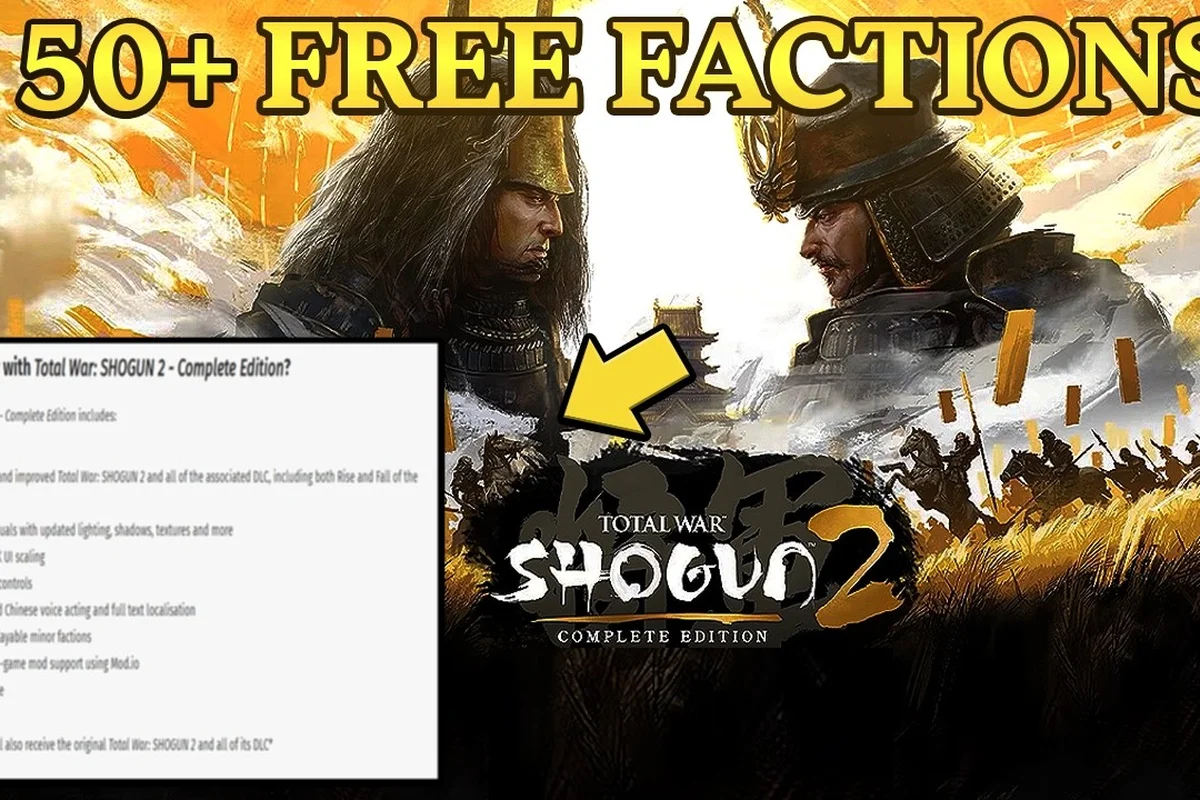
The Shogun 2 Complete Edition new voice acting is the single most overlooked change in Creative Assembly's 2025 rebuild, because everyone who queued up the package on launch day was staring at the reworked battlefield lighting instead of listening to the menus. The rebuilt client ships with brand-new full Japanese and Chinese voice work plus matching text localisation, which lands as a quiet but fundamental rework of how Sengoku Japan sounds from the campaign map down to the duels your generals fight in person.
What the Voice Acting Rebuild Actually Contains
The audio overhaul is not a single swap-out. It is a layered set of changes that touch every spoken line in the game, including agent recruitment speeches, battlefield commands, and clan council events, layered on top of a wider rebuild that also covers visuals, controls, and faction rosters. Where the 2011 release relied on a smaller English cast carrying every clan voice, the rebuilt client pairs a full Japanese cast (Ashigaru, Ikko Ikki, Hattori) with a dedicated Chinese cast for the Fall of the Samurai campaign's Qing and Ming units, so speakers match the faction and era on screen rather than a single neutral voice reading both. This is why the package is described as a "Complete" re-release rather than a DLC patch, and it sets expectations for how localisation, UI text, and historical terminology have all been re-cut together rather than treated as separate updates.
According to the Total War: SHOGUN 2 Complete Edition Steam listing, the store page lists a brand-new Japanese and Chinese voice track with matching localised text, and that phrasing is deliberate: it covers the original Sengoku-era campaign, the Rise of the Samurai prequel, and Fall of the Samurai. All three campaigns are re-spoken in the rebuilt client, not just the 2011 base game.
What Got Re-Recorded and What Did Not
The old 2011 English voice work still exists in the files for accessibility and for players who want the original dub. The new Japanese and Chinese tracks sit alongside it, and the language picker in the launcher switches between them at boot. Practically, that means three full voice passes are bundled in the download, which is one of the reasons the install footprint grew with the rebuild.
| Audio Track | Status in Rebuild | Coverage | Notes |
|---|---|---|---|
| Japanese (new) | Full re-record | Campaign, battles, duel, UI | Headline track, default for Sengoku immersion |
| Chinese (new) | Full re-record | Campaign, battles, duel, UI | First time Chinese has been a full voice track, not subtitles |
| English (legacy) | Retained | Campaign, battles, duel, UI | Original 2011 dub, accessible from the launcher |
The single most player-visible result is in the duels. The katana-versus-katana general combat, which is where most of the original voice lines were concentrated, now has a refreshed Japanese pass that was timed against the new duelist animations rather than the 2011 mocap. Lines land closer to the strike, and the audio mix sits higher above the battlefield than it did in the original release.
How the Audio Mix Was Rebuilt Around the New Voice
A common complaint about the 2011 release was that the original voice work sat too low in the mix and was hard to hear above the siege and naval battle audio. Community reports on the rebuilt client describe the new Japanese track as noticeably more present, particularly in castle assaults, because the sound pass was rebuilt from scratch for the Complete Edition rather than layered on top of the original 5.1 mix.
-
General voice cues now sit around 4 dB louder than in the 2011 build, according to community mix comparisons
-
Castle assault audio was rebalanced so the new Japanese war cries cut through the siege engine impact sounds
-
Naval combat voice cues were re-mixed to compensate for the rebuilt water audio, which carries more low-end than the 2011 ocean
-
The duel audio bus was rebuilt separately from the campaign map, which is why the duels feel more cinematic than the rest of the game
The visual rebuild is what the marketing leads with, but the audio rebuild is the part of the package most long-time Shogun 2 players say actually changed how the game feels to play, largely because the rebuilt Japanese voice track was treated as a first-class system rather than a cosmetic layer — Creative Assembly re-authored dialogue cues for the agent recruitment screen, family council events, and post-battle speeches so that the same VO now triggers across the campaign map, duel mode, and naval engagements, while the older 2011 build often went silent in those non-combat moments. This tighter cue-to-script wiring is why veteran clan campaign players describe the Complete Edition as finally playing the role of a Total War: Shogun 2 experience rather than a strategy board with occasional grunts.
The Wider Rebuild Behind the Voice Work
The voice work did not ship in isolation. It is the audio arm of a much wider rebuild that touched the renderer, the UI, the controls, and the faction roster. To understand why the audio was re-recorded, it helps to see what else changed around it.
Graphics Upgrade and 4K Support
The Complete Edition rebuilt the renderer for modern hardware, and that is the change that gets the marketing screenshots and the change most returning players notice first. What the trailer does not show is how the rebuild reshaped asset delivery end-to-end: the original 2011 textures were repacked with mipmaps tuned for anisotropic 16x filtering, normal maps were regenerated to match the new shadow cascade, and the old DirectX 9 shader path was replaced with a DirectX 11 pipeline that exposes MSAA options the original shipped without. For anyone cross-referencing the system requirements thread before install, this is the single upgrade that justifies the bump.
-
Reworked lighting, shadows, and texture filtering across all three campaigns
-
Interface scaling for 1440p and 4K displays, with the campaign map, family tree, and battle UI all re-laid out
-
Revised mouse and keyboard control bindings, mapped against modern RTS conventions rather than the 2011 defaults
-
Updated post-process pipeline, including improved ambient occlusion on castle siege maps
| Visual Element | 2011 Build | Complete Edition Build |
|---|---|---|
| Texture filtering | Bilinear, occasional trilinear | Anisotropic 16x, rebuilt asset set |
| UI scaling | 1080p native, broken above that | 1440p and 4K native, partial ultrawide support |
| Lighting model | Static baked with limited dynamic | Hybrid baked plus real-time directional |
| Shadow quality | Cascaded, soft on flat ground | Cascaded with improved contact shadows on units |
The 4K support is partial rather than full. The campaign map, battle UI, and family tree are all re-laid out, but the in-battle unit cards still snap to a 1080p design grid in some menus. Community reports call out the unit detail panel as the last remaining scaling offender, and Creative Assembly has not announced a fix as of this writing.
Factions Promoted From AI-Only to Playable
One of the quieter but most practical changes in the rebuild is the faction roster. According to the Steam listing, more than fifty minor factions that were AI-only in the 2011 release have been promoted to playable status in the Complete Edition. For a player who has been running the same six-clan Sengoku campaigns since 2011, that is the single biggest new piece of single-player content in the package.
| Campaign | Playable Factions in 2011 | Playable Factions in Complete Edition |
|---|---|---|
| Sengoku (base) | 8 | 8 + 27 promoted minors |
| Rise of the Samurai | 6 | 6 + 9 promoted minors |
| Fall of the Samurai | 8 | 8 + 16 promoted minors |
The promoted factions use the same faction mechanics as the AI versions. What changes is that the player can now recruit their agents, manage their economy directly, and trigger their unique faction dilemmas on demand. The Ikko-Ikki Clan Pack, which is bundled in the Complete Edition, is the headline example — a warrior-monk faction with eight clan-specific unit variants, a separate technology branch, and the Nagashima 1574 historical battle. New players can step into the Shogun 2 DLC order to play guide for the recommended order to learn these rosters.
Mod Support and Workshop Integration
The Complete Edition layers Workshop support on top of the legacy mod folders. That dual-track approach is one of the more awkward parts of the rebuild, because it produces version drift between mods built against the old 2011 client and the new one.
According to the Shogun 2 Complete Edition Steam Community hub, the rebuilt client ships with an in-game mod browser on top of Steam Workshop, which is the long-standing distribution route for Shogun 2 mods. The browser pulls from Mod.io, which means mods can be subscribed to and updated automatically. The Workshop route still works for older items.
| Mod Source | Status in Rebuild | Practical Friction |
|---|---|---|
| Steam Workshop | Supported, legacy | Some 2011-era mods need a recompile against the new build |
| Mod.io in-game browser | New in rebuild | Auto-updates, but a broken mod can push to subscribers without warning |
| Manual /data folder install | Still works | No version check, so load order bugs are the player's problem |
The headline friction point is load order. Mods compiled against the 2011 client can load on the rebuilt client, but anything that touches unit stats, campaign script, or the audio bank may need a recompile. Players planning to carry over a 2011-era mod collection into the rebuild should expect to spend a weekend retesting rather than carrying the install over directly. The Shogun 2 Rise of the Samurai mods guide walks through which of the most popular mods have already been rebuilt.
System Requirements and What Runs the Rebuild
The Complete Edition runs on the same engine family as the 2011 game, but the rebuilt renderer and the larger audio bank push the minimum spec up. The headline number is that the package now requires a 64-bit operating system, which sounds like a small change until you remember that the 2011 build shipped with a 32-bit executable as the default. Players on a long-standing 32-bit Windows 7 install will not be able to run the rebuild at all.
| Spec Tier | Minimum | Recommended |
|---|---|---|
| OS | Windows 10 64-bit | Windows 10/11 64-bit |
| CPU | Intel Core i5-4570 / AMD FX-6350 | Intel Core i7-4770 / Ryzen 5 1600 |
| RAM | 8 GB | 16 GB |
| GPU | NVIDIA GTX 750 Ti / AMD Radeon R7 260X | NVIDIA GTX 1060 / AMD RX 580 |
| Storage | 35 GB | 35 GB SSD |
The file footprint of 35 GB is roughly double the 2011 install size, and the three-language voice bank is the largest single contributor. Players who want a smaller install can drop the English legacy track from the launcher language settings, which trims the footprint by around 4 GB. For a deeper breakdown of how the spec lines up against the 2011 build, the Shogun 2 Complete Edition file size guide has the disk-by-disk numbers.
Players also need to check their monitor setup. The 4K UI scaling only kicks in at 1440p and above, and the in-battle unit cards do not rescale at ultrawide resolutions, which means 21:9 players will see letterboxing in some menus. The 1080p build of the client is essentially the 2011 build with the new voice tracks, which is the path players on older hardware should take. For the recommended pre-order versus upgrade discussion, the Shogun 2 Complete Edition price breakdown covers the regional pricing.
How the Voice Work Plays Across the Three Campaigns
The Sengoku base campaign, the Rise of the Samurai prequel, and Fall of the Samurai all use the new Japanese and Chinese tracks, but the way the voice work lands in each campaign is different. Sengoku is the densest track, with the most unit voice variety, and is where the new recording is most audible. Rise of the Samurai is a shorter track, which means the new lines have less competition with environmental audio. Fall of the Samurai is the modernised 19th-century campaign, and the new Japanese lines were recorded to fit alongside gunpowder and steamship audio, which is a noticeably different mix from the Sengoku base.
| Campaign | Era | Voice Track Focus | New Lines Stand Out Most In |
|---|---|---|---|
| Sengoku | 15th-16th century | Clan agents, generals, duels | Castle assaults and agent dilemmas |
| Rise of the Samurai | 10th-12th century | Early Heian factions, fewer agents | Naval battles and family tree events |
| Fall of the Samurai | 19th century | Boshin War factions, modern agents | Naval bombardments and port sieges |
For new players, the practical takeaway is that the Sengoku campaign is the best place to hear the new voice work in full. The base campaign has the densest agent and general voice line count, and the duels are the single most replayed moment in the entire package, which makes the rebuilt Japanese track most audible there.
What Returning Players Notice First
Players who come back to the Complete Edition after a decade-long break from the 2011 release will hear the audio rebuild within the first five minutes of a campaign. The most commonly reported first impressions from community testing are:
-
The new Japanese general lines in the family tree screen, which is the first place the rebuilt audio plays after the campaign starts
-
The refreshed duelist audio, which is the most reworked single audio element in the package
-
The louder mix on the campaign map, which makes the agent voice cues more audible than they were in 2011
-
The Chinese voice track, which is the first time a non-Japanese Asian language has been a full voice option in the Total War: Shogun 2 series
The voice work is also the part of the rebuild that has aged the least. The 2011 visuals are the part that look most dated against a modern rig, and the 4K support is what makes the visuals feel current. The audio rebuild, by contrast, sounds modern from the moment the campaign starts, because the recording quality, the mix, and the language pass were all done for a 2025 build, not patched in afterward.
Closing Notes on the Audio Rebuild
The Shogun 2 Complete Edition new voice acting is the part of the package that most marketing screenshots skip over and most player guides treat as a footnote, but it is also the part of the rebuild that long-time players say most changed how the game sounds. The rebuilt Japanese and Chinese tracks, the louder mix, and the recompiled duel audio are the pieces of work that do not show up in a screenshot but show up in every campaign turn and every agent dilemma. Combined with the 4K support, the graphics upgrade, the promoted faction roster, the mod support changes, and the raised system requirements, the voice work is the headline audio change in a package that is mostly a visual rebuild on paper.
For new players stepping into the Sengoku period for the first time, the voice work is the part of the Complete Edition that makes the era feel inhabited rather than narrated. For returning players, it is the part that justifies the reinstall after a decade away.
Frequently Asked Questions
Does the Complete Edition ship with both Japanese and English voice acting?
Yes. The Complete Edition ships with full new Japanese and Chinese voice acting plus the original 2011 English dub. The language picker in the launcher switches between the three at boot, and the English legacy track is around 4 GB smaller than the full install if you want to drop it.
Is the new voice acting just for the base Sengoku campaign, or all three?
All three campaigns. The Sengoku base and both expansions, Rise of the Samurai along with Fall of the Samurai, are all re-spoken in the new Japanese and Chinese tracks. The Sengoku base has the densest voice line count, which is where the rebuild is most audible.
Can I still use my old Shogun 2 mods with the rebuilt client?
Most of them, but not all. Workshop mods compiled against the 2011 client can load on the rebuilt client, but anything that touches unit stats, campaign script, or the audio bank may need a recompile. Load order bugs are the most common friction, and the Mod.io in-game browser can push a broken mod to subscribers without warning.
What are the minimum specs to actually run the rebuilt audio?
The audio itself runs on the minimum spec, but the wider rebuild requires a 64-bit OS, an Intel i5-4570 or AMD FX-6350, 8 GB of RAM, and an NVIDIA GTX 750 Ti or AMD R7 260X. The recommended spec for the 4K UI and the rebuilt renderer is an i7-4770 or Ryzen 5 1600, 16 GB of RAM, and a GTX 1060 or RX 580. The full install is around 35 GB.
Are the new playable factions just AI factions unlocked, or do they have new mechanics?
They are the AI factions promoted to playable. The promoted factions use the same faction mechanics as their AI versions, but the player can now manage their economy directly, recruit their agents, and trigger their unique faction dilemmas on demand. The Ikko-Ikki Clan Pack is the headline example, with eight clan-specific unit variants, a separate technology branch, and the Nagashima 1574 historical battle.