
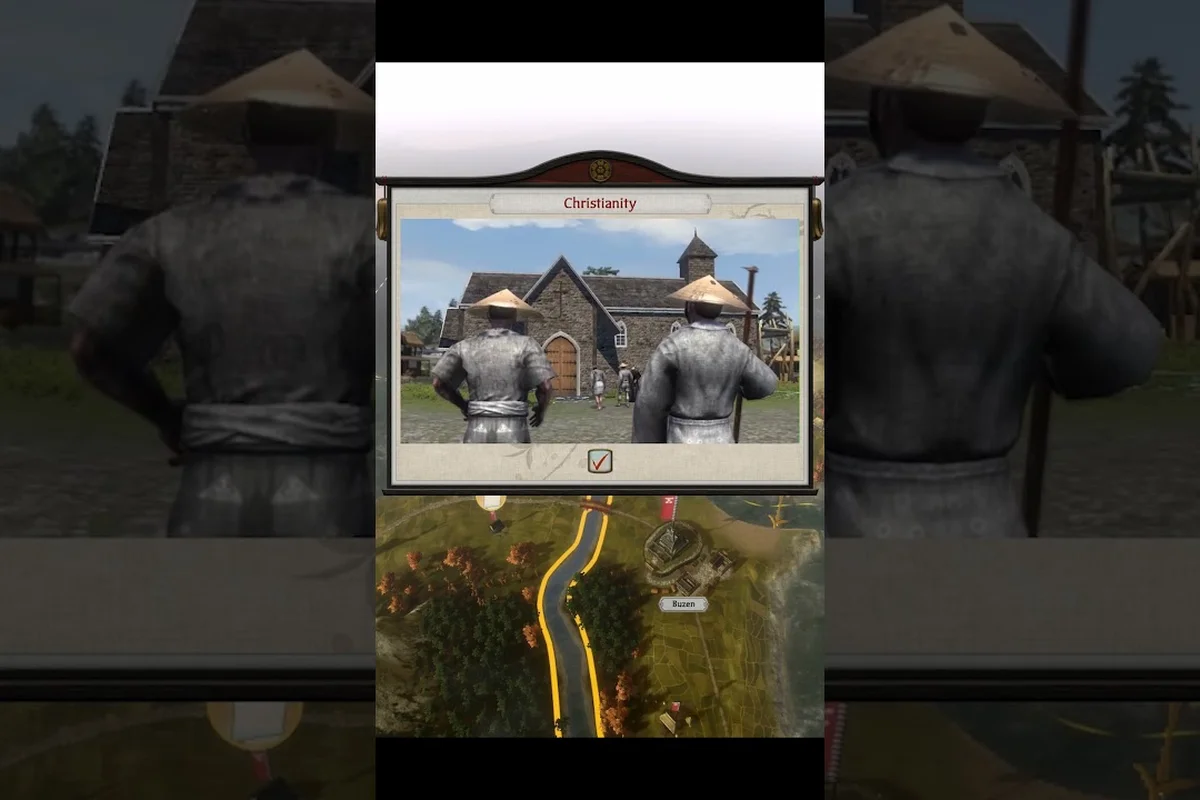
Christianity in Total War: SHOGUN 2 is a high-risk, high-reward decision. Four of the ten base-game clans begin with the foreign faith — the Shimazu, Oda, Ikko Ikki, and Hattori — and each one trades the default Shinto-Buddhist toolkit for Jesuit missionaries, matchlock arsenals, and unique tech-tree branches that no other clan ever sees. The catch is that the moment a clan converts, every Buddhist, Shinto, and Ikko neighbour on the island loses public-order stability near your borders and begins massing armies to erase you before your foreign trade routes stabilise the economy.
This Total War: Shogun 2 christianity guide walks through how to convert intelligently, when to hold off, and how to push through the political firestorm that follows. Players who already understand the basics of the Total War Shogun 2 beginner guide will get the most out of the following sections, because every recommendation here assumes you can already manage food surplus, seasonal levies, and basic army composition.
Why the Christian Faction Path Is So Dangerous
Christianity in Shogun 2 is more than a flavour choice. It is a complete re-skin of the campaign economy, the agent roster, and the diplomatic landscape. Understanding what changes the moment a clan converts is the foundation of any christianity guide worth reading.
The Core Trade-Offs of Converting
When a clan adopts Christianity, it gains the Jesuit missionary — a slow-spreading but extremely durable agent who functions as a one-man religion machine, a diplomacy booster with Catholic-leaning foreign powers, and a soft counter to enemy monks because Jesuits can convert their targets back to Shinto or Buddhism. In exchange, the clan loses access to warrior monks (the aggressive close-combat infantry unit that every other clan unlocks through temple tech) and sees a permanent public-order debuff in every province where the dominant faith is not yet Christianity.
| Conversion Effect | Buddhist / Shinto Clan | Christian Clan |
|---|---|---|
| Default faith | Shinto-Buddhist syncretism | Catholic Christianity |
| Religious agent | Monk (combat + spread) | Jesuit missionary (spread + diplomacy) |
| Unique melee unit | Warrior monks (unlock via temple tech) | Nanban troops (gunpowder unit) |
| Foreign trade bonus | Standard +0.5 wealth per route | +1.0 wealth per route with Catholic nations |
| Public order in non-Christian provinces | Stable | -4 per province until converted |
| Diplomatic reception | Neutral baseline | +10 with Portugal / Spain, -15 with all daimyo clans |
| Realm Divide trigger | Standard | Standard (the faith does not change the threshold) |
The data above is consistent with the agent and religion systems documented in the Total War: Shogun 2 Beginner's Guide. Numbers like the +1.0 trade bonus reflect the foreign-trade economy widely reported by the Shogun 2 community on Steam forums, and they are the single largest reason experienced players convert — double-income trade routes pay for two full-stack armies by mid-game.
Why Daimyo Neighbours Declare War So Quickly
Diplomacy in Shogun 2 uses a hidden religion-based attitude modifier that is independent of normal diplomatic relations. When a clan converts to Christianity, every Buddhist daimyo within ten provinces receives a flat -15 diplomatic penalty that decays very slowly. Combined with the -4 public-order debuff in border provinces, the typical Christian campaign follows a predictable rhythm: convert → lose 2-3 trade partners → see 4-5 daimyo declare war in the first ten turns → fight a desperate multi-front war until Jesuit spread stabilises order.
Players who understand that this penalty is not a mistake but a deliberate design choice can plan for it. Treat the first 25 turns as a defensive sprint rather than an expansion window: station a full yari ashigaru unit plus one bow kobaya garrison in each home castle, cancel trade agreements with hostile Buddhist daimyo before the -15 attitude modifier triggers, and hold yari cavalry in reserve on the home island to intercept the inevitable 4-5 war declarations. Once Jesuit spread stabilises public order around turn 25-30, you can pivot to offensive expansion toward Kyoto with monk converts reinforcing your army's morale, shifting from survival to the realm divide path with provinces already consolidated rather than fractured.
Choosing a Christian Clan That Fits Your Playstyle
Not all four Christian clans are created equal. Each one starts in a different region with a different neighbour profile, and the right clan choice can turn the early conversion crisis into a manageable inconvenience instead of a campaign-ending spiral.
Comparing the Four Start Positions
| Clan | Starting Region | Immediate Neighbours | Conversion Difficulty | Unique Edge |
|---|---|---|---|---|
| Shimazu | Southern Kyushu | Ito, Otomo, Chosokabe | Easy | Coastal trade, isolated starting position, weak neighbours |
| Oda | Owari (central Honshu) | Imagawa, Omi, Iga, Tsukigata | Hard | Unique ashigaru tech tree, aggressive expansion tools |
| Ikko Ikki | Kaga (Hokuriku coast) | Asakura, Hatakeyama, Uesugi | Extreme | Peasant economy, -1 to enemy public order in all provinces, but surrounded |
| Hattori | Iga province (central) | Multiple central daimyo on all sides | Hard | Ninja + metsuke synergy, tight provincial defence bonuses |
The Shimazu are the canonical "first Christian campaign" choice because they start in southern Kyushu with the smallest, weakest daimyo neighbours and immediate access to the sea. Hattori is the most defensible because Iga is a single mountain province and the clan can turtle through the early crisis while Jesuits spread in foreign markets. Oda is for players who want to convert after the early game — the Owari start is brutalised by the Imagawa, and adding a religion penalty on top is suicidal. Ikko Ikki is the hardest: their peasant economy is amazing long-term, but being surrounded by hostile daimyo with no food surplus buffer makes the conversion window a knife-edge.
Shimazu as the Default Recommendation
For most players approaching a Shogun 2 christianity guide for the first time, the Shimazu campaign is the right starting point. Their geographic isolation gives ten extra turns before the first serious war declaration, their coastal location unlocks the foreign trade routes that make Christian economics viable, and the Otomo clan to the west is also Christian — meaning your starting religion actually gives you a natural ally, not an enemy, in the first twenty turns.
Players who have already completed one Shimazu victory and want a new challenge should try the Hattori start, because ninja + metsuke + Jesuits give you three different agent types that can each handle a different threat layer, and the Iga mountain province can be defended with a single army against three attackers for thirty-plus turns.
When to Convert: Timing the Religion Switch
The biggest mistake new Christian players make is converting on turn one. Conversion is permanent and the diplomatic penalty it triggers is unavoidable, so timing matters more than the choice itself. This section covers the windows that experienced players target.
Pre-Conversion vs Mid-Game Conversion
Most campaign walkthroughs for a Shogun 2 christianity guide default to recommending conversion on turn one, but the data is more nuanced. The two viable windows are turns 1-5 (before your economy is established) and turns 35-50 (after your first province is fully developed). Anything in between tends to fail because your income cannot fund a war while your public order is collapsing.
| Conversion Window | Economy Ready? | Military Ready? | Diplomacy Risk | Verdict |
|---|---|---|---|---|
| Turn 1-5 (immediate) | No | Partially | Low (no allies to lose) | Viable for isolated starts (Shimazu) |
| Turn 15-25 (mid-early) | Partial | Partial | High (first ally signs trade deal) | Avoid |
| Turn 35-50 (mid-game) | Yes | Yes | Medium (well-known clan by now) | Viable for central starts (Hattori, Oda) |
| Turn 60+ (late) | Yes | Yes | High (Realm Divide imminent) | Avoid — wastes the Nanban trade bonus |
The mid-game window works for the Hattori and Oda clans because by turn 35 you have had time to research the first two military techs, recruit one full stack, and sign a non-aggression pact with at least one neighbour — meaning the diplomatic penalty of conversion does not immediately cascade into a three-front war. Players wanting a deeper look at ally management can cross-reference the Shogun 2 diplomacy explained guide for the exact attitude numbers that determine whether a non-aggression pact survives the conversion penalty.
Pre-Conversion Checklist
Before triggering the religion switch in Shogun 2, you need to stage your capital province as a defensive strongpoint — because the moment Christianity is adopted, every non-Christian clan on the map gains a diplomatic casus belli against you through the Nanban trade mechanics and the -4 public order debuff from the Christianity province effect stacks on top of your existing unrest. Treat the conversion like the opening turn of Realm Divide: consolidate your koku income, pre-build missionary slots in the Catholic chapel chain, and screenshot your current trade-route panel so you can immediately restore Portuguese or Spanish trade agreements before AI factions exploit the diplomacy penalty that scales with the number of provinces you have converted.
-
One full-stack army defending your capital — not standing in a foreign siege
-
Two trade agreements with Catholic-leaning foreign powers (Portugal, Spain) ready to renew immediately after conversion
-
Food surplus of at least +4 in your capital so the -4 public-order debuff does not trigger a rebellion in turn one
-
First missionary already trained in your capital to begin spreading Christianity the moment the conversion fires
The economy collapse is the silent killer, not the war declaration. In practical terms, a capital running a +4 food surplus and one full-stack yari ashigaru garrison can absorb the Christianity adoption debuff and the simultaneous -4 diplomatic penalty from Nanban trade mechanics without spawning a rebel army, whereas a province sitting at +1 surplus typically flips to unrest by turn 2 post-conversion — forfeiting the missionary slot, the Catholic chapel chain momentum, and the chapel-trained Kirishtan units you queued before adopting the religion. Treat your koku income like the barometer of a Realm Divide run: if your treasury cannot fund two retraining cycles of ashigaru while paying upkeep on a missionary and a ninja network, the Jesuit you recruit on conversion turn will never finish spreading Christianity past province one, and the clan collapses into civil war before any foreign daimyo even marches on Kyoto.
Surviving the Post-Conversion Firestorm
The first twenty turns after conversion are a sprint. The combination of -4 public order, -15 diplomacy with every daimyo, and the inevitable war declarations is the single hardest stretch in the campaign. This section covers the actual mechanics of pulling through it.
Defending Against Multi-Front Wars
The key insight is that you do not need to win these early wars — you need to not lose them. Holding your capital and your trade cities is the entire goal until Jesuits stabilise the faith. Every unit of military effort spent pushing into enemy territory is a unit not spent defending the next wave.
| Threat | Counter | Priority |
|---|---|---|
| Multi-stack army on capital | Matchlock ashigaru + yari wall on settlement, never engage in open field | Critical |
| Public order rebellion | Keep one monk unit garrisoned + garrison building chain | High |
| Missionary getting assassinated | Misdirect — station a metsuke in capital to detect and execute enemy ninja | High |
| Trade route raided by Wako pirates | Station one light ship stack on the trade node | Medium |
| Agent spam (ninja / geisha in your provinces) | Ninja in counter-intelligence stance, plus building the metsuke chain | Medium |
The matchlock ashigaru are the most important unit in this stretch because their missile DPS is high enough to shred enemy yari charges before they reach the walls, and they are cheap enough to recruit three full stacks by turn 25. The standard opening after conversion is two matchlock ashigaru, one yari ashigaru, one naginata samurai, and one general — that composition holds against most AI doomstacks until the Jesuits can convert two adjacent provinces.
Missionary Spread Strategy
Jesuits spread Christianity at roughly 0.5% per turn per active missionary in a province, which is much slower than the default monk spread, but Jesuits are extremely hard to kill (they have 80% missile block and high melee defence). Station one Jesuit in each of your core provinces and a second Jesuit in any neighbour's province where you have a non-aggression pact — this lets you convert your allies' border provinces without spending a single diplomatic favour.
The hidden trick is that the +1 diplomatic bonus per active Jesuit in a foreign capital compounds over time. By the time you have three Jesuits stationed in three foreign capitals, every diplomatic request lands with a +3 to +5 reception, which is the difference between an accepted trade deal and a rejected one.
How to Become Shogun Through the Christian Path
The Shogun 2 how to become shogun question is fundamentally a question about victory conditions, and Christianity does not change the political requirements. You still need 25 provinces, the three specific regions (Kanto, Kinai, and either Tohoku or Saigoku), and the loyalty of the Emperor. What Christianity changes is how fast you can get there.
The Realm Divide Timing Problem
Realm Divide fires when any one clan owns more than half the map's provinces, and at that point every non-vassal AI clan declares war simultaneously. For a Christian clan, this is especially brutal because the religion penalty is already active against most of the map, meaning there is no diplomatic cover during the divide. This is the core of any honest Shogun 2 realm divide guide: the late-game crisis is unavoidable, and the only variable is preparation.
The solution is to research the Honour and Daimyo honour tech lines (the ones that unlock vassal-creation gifts and the Shogun legitimacy bonus) before Realm Divide fires, and to convert at least 3-4 AI daimyo to vassal status during the mid-game. Vassals do not join the Realm Divide war against you — they are technically part of your coalition — so a player who enters Realm Divide with three vassals only fights the 6-8 AI clans that are not yet vassalised instead of the 12-15 they would otherwise face.
Surviving Realm Divide as a Christian Clan
The Shogun 2 how to survive realm divide question has three workable answers, and the right one depends on your current economy, vassal reliability, and how many Christian allies you maintained before the trigger fired at turn 30-50 — typically the date the clan reaches roughly 60 provinces, which is when the Honno-ji-style mechanic penalises expansion and every non-Christian faction in Japan declares war on you simultaneously, regardless of prior trade agreements or military alliances.
| Strategy | When to Use | Key Building | Key Tech |
|---|---|---|---|
| Defensive turtle | Economy is weak, vassals are unreliable | Fortress chain in all border provinces, three layered walls | Castle defences + master horsemen |
| Shock offence | Economy is strong, vassals are solid | Forward siege camps + supply buildings | Matchlock mastery + military reforms |
| Diplomatic carve-up | Surrounded by weak neighbours | Trade ports in all non-coastal directions | Mercenary discounts + foreign trade |
The defensive turtle is the safest answer for first-time Christian campaigns because fortress walls can hold 3-1 odds for ten-plus turns, and the AI is very bad at coordinating multi-stack sieges across separate provinces. The shock offence is for experienced players who already know where the AI reinforcements spawn and can intercept them in the open field. The diplomatic carve-up is the rarest option because it requires 5+ vassals, which usually means the Realm Divide never properly fires in the first place — you have already functionally won.
For most players, the answer is a hybrid: turtle for the first 15 turns of Realm Divide while the AI bleeds itself on your fortress walls, then launch a shock counter-offensive with your fully-stocked matchlock armies against the depleted enemy stacks. The end-state of that campaign is a Shogun victory around turn 110-130, which is on the slow end for a Shogun 2 campaign but is normal for a Christian start. Players who want a deeper look at the victory conditions and the difference between short and long campaigns can reference the Shogun 2 victory conditions breakdown.
The Christian Tech-Tree Cheat Sheet
Christianity unlocks two unique tech-tree branches: the Nanban line (foreign trade and gunpowder) and the Jesuit line (missionary effectiveness and diplomacy). Picking the right order is the difference between a 90-turn Shogun run and a 130-turn grind.
Recommended Research Order
| Research Order | Tech | Effect | Approx. Turn |
|---|---|---|---|
| 1 | Foreign ports | +0.5 wealth per trade route | Turn 8-12 |
| 2 | Matchlock arms | Unlock matchlock ashigaru | Turn 14-18 |
| 3 | Jesuit training | +1 missionary action per turn | Turn 22-26 |
| 4 | Nanban shipbuilding | -30% trade ship cost | Turn 30-34 |
| 5 | Diplomatic catechism | +10 diplomatic bonus per Jesuit in foreign capital | Turn 38-44 |
| 6 | Master matchlock | +10% missile damage for matchlocks | Turn 48-54 |
The first three techs form the "survival" core. The next two are the "economy" phase that funds your late-game armies. The final research is the "Realm Divide" prep that lets your matchlocks shred the AI stacks that arrive after the divide fires.
The other useful resource to combine with this guide is the wider Shogun 2 vassal strategy and ally management breakdown, because the Jesuit + vassal combo is the single most powerful late-game combination available to a Christian clan. A single Jesuit stationing in each vassal capital prevents them from rebelling during Realm Divide, which is worth more than any one tech bonus in the entire tree.
Christian Campaign FAQ
What is the best Christian clan for a first conversion run?
The Shimazu are the strongest beginner-friendly Christian start because they begin in southern Kyushu with weak daimyo neighbours, immediate coastal access for trade routes, and the Christian Otomo clan to the west as a natural ally. Players who want a harder challenge can try Hattori next, but the Shimazu should always be the first Christian campaign.
Do Jesuits replace monks or do I keep both?
You keep access to monks even as a Christian clan, but you lose the warrior monk combat unit. The monk agent can still inspire armies and spread faith, but missionaries are faster at conversion and tougher in combat, so most players disband their monks by turn 20 and use the saved upkeep to fund a second Jesuit.
When exactly does Realm Divide fire and can I delay it?
Realm Divide triggers when any clan holds more than half the map's provinces. There is no delay mechanic, but you can soft-delay it by vassalising the largest AI clans first — vassals do not count toward the divide threshold, so a player with 28 provinces and 4 vassals (controlling 12 more) will not trigger the divide until those vassals rebel.
Should I convert on turn 1 or wait until mid-game?
The answer depends on your starting clan. For the Shimazu, convert on turn 1 because the early diplomatic loss is offset by the immediate foreign trade bonus and your weak neighbours. For Oda and Hattori, wait until turn 35-50 when you have one full-stack army and two trade agreements in place, because the central start is too dangerous to convert in the opening.
Can I still achieve the Shogun victory as a Christian clan?
Yes. The Shogun victory conditions are unchanged by religion — you still need 25 provinces, the three specific regions, and the Emperor's loyalty. The Christian path is slower (typically 110-130 turns instead of 85-100) because the diplomatic penalties delay vassal creation, but the foreign trade bonus compensates by giving you a stronger economy than any non-Christian clan has at the same stage.